When Tanabata draws near, you set up a bamboo branch for your children or grandchildren and let them write their wishes on colorful paper strips.
But when it is your own turn, do you just scribble a single line in ballpoint pen on a slippery 100-yen-shop strip? It is a once-a-year occasion, yet somehow the grown-ups end up treating their own wish as an afterthought.
(Tanabata, Japan’s “Star Festival” celebrated on July 7th, is the night when people write wishes on small paper strips called tanzaku and tie them to bamboo.)
That small sense of “something missing” disappears in an instant once you simply change the paper of the strip itself.
In this article, we introduce the charm of washi (handmade Japanese paper) tanzaku that makes the 2026 Tanabata a little more special, along with two recommended papers from Izumo that you can choose depending on the kind of wish you want to make. By the time you finish reading, you may find yourself looking forward to this year’s Tanabata.
Why washi is the right choice for a grown-up’s Tanabata wish
To put the conclusion first: nothing suits a grown-up’s Tanabata better than a washi tanzaku.
The reason is simple — on washi, a wish suddenly looks special. Mass-produced, film-like paper lets the ink skate across the surface, so whatever you write or display ends up feeling businesslike. If your heart isn’t in it, that’s not your fault; it’s the paper’s.
Take the very same wish — “May my family stay healthy.” The impression changes completely depending on the paper.
Written in ballpoint on a glossy strip, it reads like an application form. But soft, gently bleeding brush strokes on washi carry the warmth of a handwritten letter. The same words, yet the weight they convey is entirely different.
That is exactly why grown-ups — who have handed the starring role of Tanabata to the children for so long — should try a washi tanzaku at least once.
Three things only washi can do: bleed, color, and keep
There are three clear reasons a washi tanzaku looks so elegant. Its way of letting ink bleed, the way it brings out color, and how well it keeps over time — none of these are things ordinary Western paper can match. Let’s look at them one by one.
Bleed | Brush-pen letters turn into a heartfelt note
Washi has long fibers that receive ink softly. The edges of each character bleed gently, so even the same words take on their own expression.
Even a simple “thank you” looks far more heartfelt when the strokes are allowed to bleed.
And if you are not confident with a brush pen, washi quietly helps you out — the bleed lends your handwriting a character all its own.
Color | It blends beautifully on the bamboo
Washi gently lets light through, and that is how its colors come alive. By a window or under indoor lighting it looks lovely, and it never turns out cheap in photographs.
When all the family’s strips hang in a row, yours is the one that catches the eye.
Even a Tanabata snapshot taken on your phone becomes noticeably more refined the moment a single sheet of washi joins the picture.
Keep | Your wish can last until next year
Washi is durable and resists damage even as the years pass.
Tuck the strip you wrote this year into a notebook or photo album, and when you look back next year it becomes a little diary entry.
Looking back and thinking, “So this is what I wished for last year,” is a surprisingly warm moment — and all the more joyful if the wish has come true.
Comparing washi tanzaku: Izumo Kumokami or Gampi — which suits you?
Even within washi tanzaku, the type of paper changes the impression considerably.
At Washinkobo, we recommend two papers crafted in the home of Japanese paper, Izumo in Shimane Prefecture: “Izumo Kumokami” (izumo-kumokami) and “Gampi” (ganpi).
Here is a rough guide. If you want vivid color and a one-of-a-kind sheet of your own, choose Izumo Kumokami.
If you want to set down a more formal, dignified wish, choose Gampi.
If you can’t decide, it’s perfectly fine to split them by purpose — the lively Izumo Kumokami for the grown-ups and children together, and the quiet Gampi for a more solemn wish.
In the two sections below, we introduce the appeal of each in more detail.
Izumo Kumokami tanzaku | A one-of-a-kind sheet for “your own wish”
If there is a wish you feel “this year, this is the one,” the Izumo Kumokami tanzaku is perfect for you.
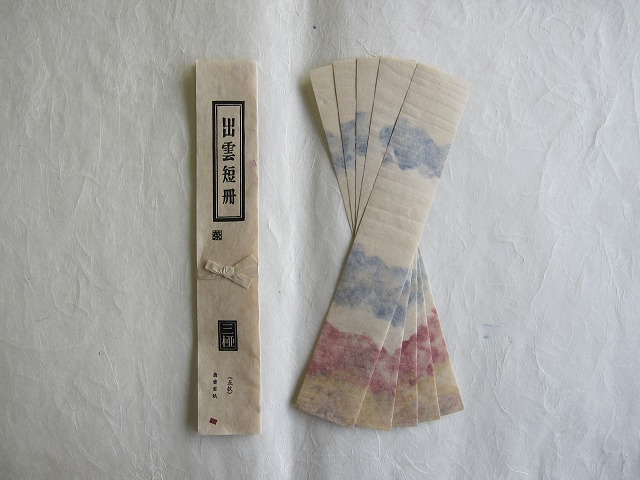
The reason: no two sheets share the same pattern — each is truly one of a kind.
Three colors — indigo, crimson, and ochre — draw a different cloud-like bleed across every single sheet.
True to its name (kumo means “cloud”), Izumo Kumokami is washi hand-formed one sheet at a time in the Izumo region of Shimane. So even if you line up five sheets, no two patterns are ever alike.
White lettering stands out crisply against the colored background, and hung on the bamboo it looks like clouds drifting across the night sky.
Write a once-in-a-lifetime wish like “This year, finally — to the place I’ve always longed to visit,” and the beauty of the paper and the wish overlap, lifting your spirits every time you look at it.
It also makes a delightful gift for children and grandchildren — a one-of-a-kind tanzaku in all the world.
Gampi tanzaku | A refined sheet for the grown-up who wants to “wish properly”
For formal wishes — a milestone at work, the health of your family — we recommend the Gampi tanzaku.
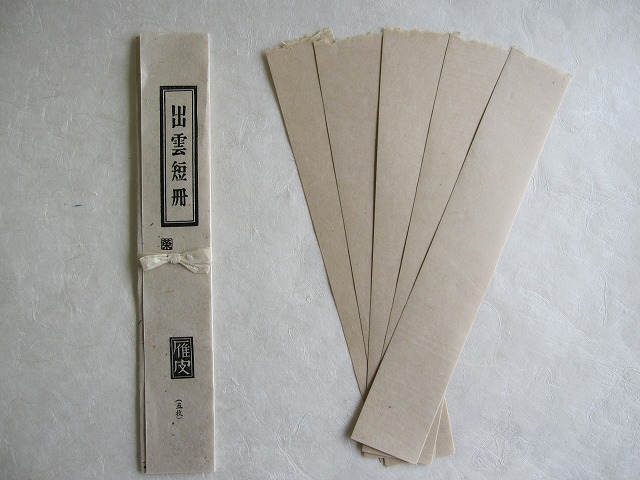
The reason lies in gampi’s uniquely elegant, finely textured surface.
Gampi is a smooth, premium washi with a faint, gentle sheen.
It is so durable and dignified that it has long been used for sutras and important records.
It pairs beautifully with the brush, too, giving your characters a crisp, composed look.
Even an earnest wish like “May everyone in my family stay well again this year” gains a proper sense of dignity on gampi.
It is also ideal for those who feel a little shy about brightly colored paper. Close out your grown-up Tanabata with a sheet that makes you sit up a little straighter.
A grown-up Tanabata the whole family can enjoy, with washi tanzaku
The last thing we want to share is this: a washi tanzaku turns an “event” into a “memory.”
The reason is that when the paper is lovely, the very act of writing becomes a pleasure.
Picture it: a different color for each family member, everyone writing their wishes together at the table.
The children lose themselves in the colorful Izumo Kumokami strips, while the grown-ups draw their pens calmly across the gampi.
Fifteen minutes with the TV off, brush in hand before the bamboo. That alone can become an unforgettable scene of this year’s Tanabata.
Each tanzaku comes as a set of five, so it divides nicely between a couple or a family.
Send a single sheet in place of a letter to children or grandchildren living far away, and it doubles as a seasonal greeting.
And after the display comes down, quietly keep your own sheet.
Next year you can look back and smile — “That wish came true, didn’t it?” That is exactly where a washi tanzaku will take you.
How to write your Tanabata wish (related article)
Not sure what to write on your strip? We have a guide to wording, the meaning of the colors, and example wishes. Read it alongside this one and your Tanabata preparations will come together nicely.
This year, make it a washi tanzaku. Your wish is sure to shine brighter than ever.
Comments