This article explains how to make Izumo Washi. The manufacturing process of Izumo Washi involves seven main stages.
- 皮剥ぎ ~ The peeling process
- 煮熟(しゃじゅく)~ The boiling process
- 灰汁抜き、塵取り ~ The removing impurities process
- 叩解(こうかい) ~ The beating process
- 紙漉き ~ The papermaking process
- 圧搾 ~ The pressing process
- 乾燥 ~ The drying process
↓ Click here for a video explaining how to make Izumo Washi!
Let’s go through the steps in order.
皮剥ぎ ~ The peeling process

The harvested raw material is steamed, and the outer black bark is peeled off using a knife. The remaining white inner bark becomes the paper.
煮熟(しゃじゅく) ~ The boiling process

The white bark is placed in a cauldron, soda ash is added, and it is boiled for about two hours until soft.
Soda ash helps soften the raw material and works to dissolve and remove impurities other than the fibers.
灰汁抜き、塵取り ~ The removing impurities process
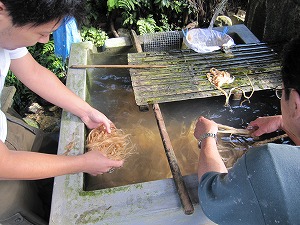
Since dissolved impurities adhere to the raw material, it is exposed to running water overnight to wash away the lye.
Afterward, any debris remaining on the bark is carefully removed piece by piece using flowing groundwater.
This process is repeated about three times.
叩解(こうかい) ~ The beating process

The fibers of the raw material are finely beaten and separated to create the “paper stock” (shiryo) ready for papermaking.
In the past, the material was beaten by hand with sticks, but now there are two stages: using a “foot-operated mortar” and using a machine called a “beater.”
For Ganpi (clove-like shrub), the fibers are first loosened using the “foot-operated mortar.” Then, final adjustments are made using water pressure in the “beater.”
紙漉き ~ The papermaking process

The raw fibers and Neri (a sticky liquid extracted from the roots of the sunset hibiscus) are placed into a vat called a Sukibune. The paper is then formed using a Sukigeta (papermaking screen).
About 250 sheets are made per day. To finish the paper with uniform thickness, the intuition of a craftsman with many years of experience is required.
Izumo Washi differs significantly from general Washi in the “mixture of paper stock and Neri” and the “handling of the Suketa screen during the process.”
- First, scoop shallowly and spread the liquid over the entire Suketa.
- Next, scoop relatively deeply, moving the screen back and forth, then left and right.
- Finally, ensure no paper stock liquid remains on top of the Suketa.
Water quality is also crucial; unless the paper is made with clean water suitable for loaches to live in, the fibers will be damaged, and high-quality paper cannot be produced.
圧搾 ~ The pressing process

The formed paper sheets are stacked one by one while still wet. This stack of Washi is called the “Shiso” (paper bed).
The “Shiso” is left overnight to allow excess water to drain. Then, pressure is gradually applied using a jack to slowly squeeze out the remaining water.
乾燥 ~ The drying process

The drained sheets are peeled off the “Shiso” one by one and dried.
Drying methods include sun-drying, where sheets are pasted onto boards, and thermal drying, where sheets are pasted onto iron plates heated by steam.
Finally, the paper is inspected to ensure the fibers are spread evenly and there are no scratches or impurities, completing the process.